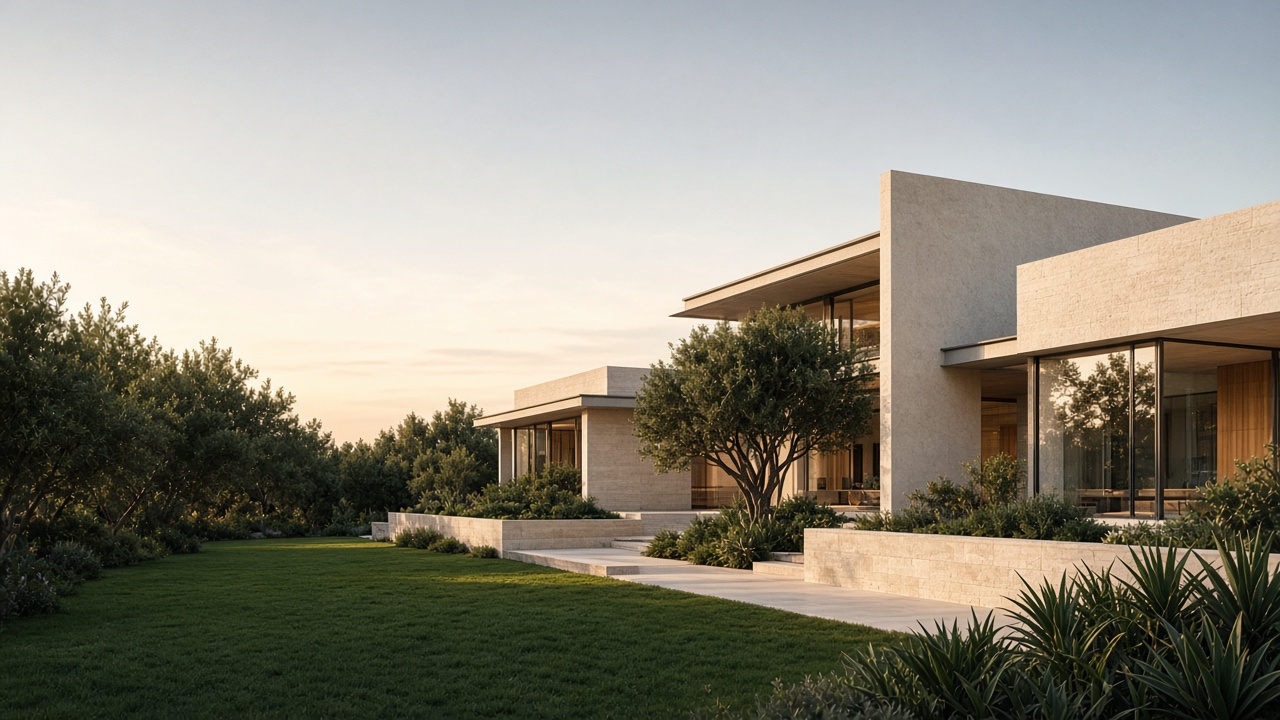
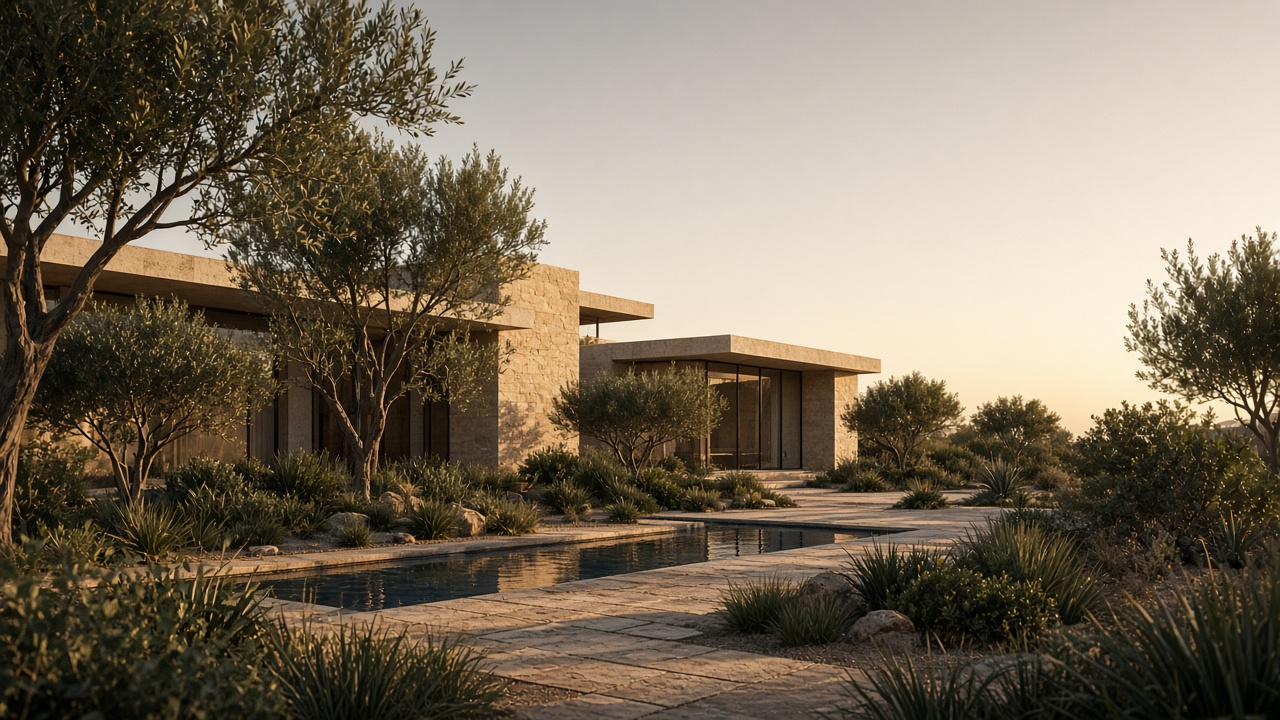
Shade Comes Before Planting
An outdoor space that has no shade will not be used for most of the year, no matter how well it is planted. The first decisions in an arid landscape are therefore about where shade will exist at the times of day people want to be outside, and what will produce it.
Shade can come from the building itself through overhangs and recesses, from built structures such as pergolas and canopies, or from trees. Built shade works immediately and predictably; trees take years and need water, but they cool the air around them rather than simply blocking the sun. Most successful schemes use both.
Hardscape Does the Structural Work
Paving, steps, walls, water features, and built seating establish how a garden is used. In a climate where extensive lawn is difficult to justify, hardscape carries more of the composition, which means it has to be detailed with the same care as interior surfaces.
Surface temperature is a real constraint. Dark, dense paving in full sun becomes too hot to walk on barefoot and radiates heat into adjacent rooms well after sunset. Lighter tones stay cooler but can produce uncomfortable glare, particularly near glazing. The answer is usually a mid-tone with a textured finish, tested on site rather than chosen from a catalogue.
Drainage deserves attention despite the arid classification. Rainfall here is infrequent but can be intense, and a courtyard or sunken terrace without adequate outlets becomes a shallow pool that discharges into the building.
- Test paving samples outdoors for surface temperature and glare
- Provide falls and outlets sized for intense, infrequent rainfall
- Detail movement joints in large paved areas to prevent cracking
- Use corrosion-resistant fixings for external metalwork near the coast
Softscape Where It Earns Its Water
Planting is most effective when it is concentrated: a dense, well-irrigated planted zone beside a terrace, along an approach, or within a courtyard delivers far more experience per litre than the same plants spread thinly across an entire plot.
Species selection should favour drought tolerance, and near the coast salt tolerance in both soil and airborne exposure. Palms, native and adapted shrubs, and hardy groundcover perform reliably. Extensive turf is the highest-consumption element in most gardens, so where it is wanted it should be limited to areas that are genuinely used.
Soil is frequently the neglected item. Imported topsoil quality, depth, and drainage determine whether planting establishes or struggles, and correcting it after planting means starting again.
- Concentrate planting beside terraces, entries, and courtyards
- Favour drought-tolerant and, near the coast, salt-tolerant species
- Limit turf to areas that are genuinely used
- Confirm topsoil depth, quality, and drainage before planting
Irrigation Is Infrastructure
Irrigation should be designed and zoned by water requirement, so that thirsty ornamental beds are not on the same line as established drought-tolerant planting. Drip and subsurface systems deliver water where roots are rather than into the air, which matters in high evaporation conditions.
Controllers, filters, valves, and pressure regulation all need accessible locations. An irrigation system that cannot be reached without lifting paving will not be maintained, and an unmaintained system either fails silently or floods.
Where treated greywater or condensate recovery is feasible, it should be considered at design stage, because retrofitting the pipework through finished hardscape is disruptive and expensive.
Dust, Wind, and Maintenance Reality
Fine airborne dust settles on everything, and it changes how surfaces look between cleanings. Highly polished paving, dark water features, and pale upholstery all show dust immediately. Textured surfaces and mid tones tolerate it better.
Wind affects planting choice and the design of shade structures. Fabric canopies need proper engineering, and tall thin planting in exposed positions needs staking and eventual replacement.
Every landscape decision carries a maintenance commitment. The most useful conversation to have with a client before handover is who will maintain the garden, how often, and with what budget, because that determines which of these choices are sustainable.
Key takeaways
- Decide where shade will exist before deciding what to plant.
- Test paving for surface temperature and glare, not only appearance.
- Concentrate planting where it will be used rather than spreading it thinly.
- Zone irrigation by water need and keep components accessible.
- Match the design to the maintenance the client will actually provide.